★★★★★ 5.0 from 84 Google reviews 20 Western Blvd, Glastonbury CT(860) 603-3930
(860) 603-3930Call the studio Book Free Assessment

Osteoporosis · Osteopenia · Low bone density

Strength training for osteoporosis & low bone density — Glastonbury, CT

Private, one-to-one strength coaching for adults 40–75+ who have been told their bone density is low, or who want to keep it from getting there. Progressive, supervised resistance training in a private studio — no crowd, no bootcamp, no guessing.

Takes about an hour. You won't be asked to work out. We talk through your history, watch how you move, and tell you honestly whether we can help.

Watch what happens to a hip over a lifetime

Two paths after 40 — with strength training, and without

Bone mass peaks in your thirties and then declines every year. Progressive resistance training is one of the few things shown to slow that decline. The animation and chart below are illustrative — shaped on published findings, not a measurement of any one person.

Bone Density Chart
Hip bone density from age 40 to 90 — with and without strength training

With Strength Training

100% of peak density
Age40bone density
at this age

Without Strength Training

100% of peak density
405060708090
Book Your Free Strength & Mobility AssessmentFree · about an hour · no workout · Glastonbury, CT
What you are looking at. From age 40 to 90 in the top of the thigh bone (the femur — head, neck and upper shaft), drawn to match what a real section or X-ray shows. The outer shell of compact bone is thin around the head and thick down the shaft. Inside is spongy bone arranged along the lines of load: one group of struts arches from the head down into the inner shaft, another arches from the outer shaft up into the head, with cross-struts between. Bone peaks around 30, holds through the thirties, and from 40 on declines every year — faster for women in the years after menopause. As bone is lost, the cross-struts and the outer arches thin and disappear first, the main load-bearing group thins, and the shaft wall thins and turns porous — which is why hip fractures happen where they do. Consistent, heavy, progressive resistance training is one of the few things shown to hold bone close to its peak through those same decades — the left bone. This is a drawing, not a scan, and not a prediction of your result — your DEXA and your physician are the authority on your own bone.
708090100404550556065707580Bone density index (peak = 100)Age the gap at 70 With training Without
Illustrative curves, indexed to peak bone mass = 100. The "with training" curve shows someone who lifts heavy, progressively and consistently for life — research shows that kind of training can hold bone density close to peak, and in many cases build it. The "no training" curve is typical age-related loss — it is not a measurement, a diagnosis, or a prediction of your result. Your DEXA scan and your physician are the authority on your own numbers.
See the numbers behind the chart
AgeNo trainingWith trainingDifference
40100100+0
4598100+2
5095100+5
558999+10
608499+15
658098+18
707698+22
757297+25
806897+29
If this sounds like you

Three people we see every week

The DEXA result

You got a scan result you didn't like

Osteopenia or osteoporosis is on the report, your doctor said "weight-bearing exercise", and nobody told you what that means on a Tuesday afternoon.

Too careful

You've stopped lifting anything heavy

You're not sure what's safe, so you've quietly stopped — and you can feel yourself getting weaker, which is the one thing you were trying to avoid.

After PT

You were discharged from physical therapy

You have a sheet of exercises and nobody watching your form. The next step after discharge is exactly where we start.

The phrase your doctor used

Is strength training the same as "weight-bearing exercise"?

Not quite — and the difference matters. Weight-bearing exercise means anything done on your feet against gravity: walking, hiking, stairs, dancing. It helps, and we want you doing it. Resistance training (lifting weights) adds load on top of gravity — squats, deadlifts, presses, loaded carries — and it is the form of exercise with the strongest evidence for actually holding or building bone at the hip and spine. Weight-bearing exercises for osteoporosis and osteopenia are the floor; progressive strength training is the ceiling.

What the research says. The LIFTMOR trial (Watson et al., Journal of Bone and Mineral Research, 2018) put postmenopausal women with low bone mass through eight months of supervised, high-intensity resistance and impact training — deadlifts, squats, overhead presses — and measured improved bone density at the spine and hip, with no fractures and essentially no injuries. The key word is supervised: every session was coached, which is exactly how we train. Bring your DEXA result and we'll show you where you are on that map.

Also see: balance and strength training for seniors · strength training after hip or knee replacement

What we do differently

Bone responds to load. So we load it — carefully.

Walking and swimming are good for you, but research on bone density keeps pointing to the same thing: progressive resistance training with meaningful weight, done with good form, over months. That is exactly what a private studio is for.
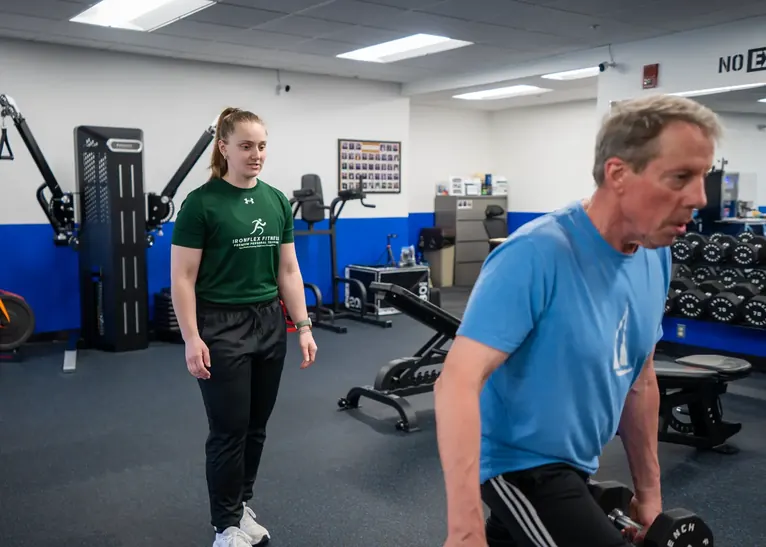
  • One coach, one client, every session. Your coach watches every rep. Nobody is across the room.
  • Loaded, not babied. We start where you are and add weight on a plan. Squat, hinge, press, carry — the movements that load the hip and spine — scaled to you.
  • Balance and fall-proofing are part of the program, not an afterthought. A fracture usually starts with a fall.
  • Post-rehab is our specialty. After PT, after surgery, after injury — we pick up where discharge left off.
IronFlex trainer coaching an older client through a loaded carry
Your first visit

How the free assessment works

About an hour. No workout, no obligation, no sales pitch with a stopwatch.

1

We listen first

Your history, your scan result if you have one, what you've been told, and what you want back.

2

We watch you move

How you stand, walk, squat and reach. What you can do comfortably today — nothing more.

3

We tell you plainly

What we'd do, how often, and what it costs — in writing. If we're not the right fit, we'll say so and point you somewhere better.

4

You decide

No decision on the day is needed. Book when you're ready, or don't.

Working with your doctor or physical therapist. We are strength coaches, not physicians. If you have a diagnosis, a recent fracture, or a spine restriction, bring your doctor's or PT's guidance and we'll build inside it. We regularly train clients alongside local physical therapy clinics and are happy to coordinate.
Common questions

Osteoporosis and strength training — FAQ

Is lifting weights safe with osteoporosis?
For most people, supervised progressive resistance training is not only safe but recommended — it is one of the few things shown to help maintain bone density. What matters is the movements you choose, how they are loaded, and who is watching. That is why every session at IronFlex is one-to-one. If you have a recent fracture or a spine restriction, bring your doctor's guidance and we will build inside it.
Do I need a referral?
No. You can book the free Strength & Mobility Assessment directly. If your doctor or physical therapist has given you restrictions, bring them and we will coordinate.
What if I've never trained before?
Most of our clients hadn't. The assessment starts with what you can do today. Nobody is asked to work out on the first visit — we talk through your history, watch how you move, and tell you honestly whether we can help.
How often, and for how long?
Most clients train two to three times a week. Bone adapts slowly — think in months, not weeks — which is why the program is built to be something you can actually keep doing.
What clients say

★★★★★ 5.0 from 84 Google reviews · Best of Glastonbury 2025 & 2026

"Do yourself a favor and schedule that free introductory session — you will not regret it."— Brittany R., Google review

"He creates an environment where I feel safe, supported and empowered. Wherever you are in your fitness journey, there is a place for you here."— Jamie L., Google review

Testimonials reflect individual experiences and are not a guarantee of results.

Book your free Strength & Mobility Assessment

Private studio · 20 Western Blvd, Glastonbury, CT 06033 · Free parking

Serving Glastonbury, South Glastonbury, Rocky Hill, Wethersfield, Marlborough, Hebron, Portland, East Hampton, Cromwell and Colchester.